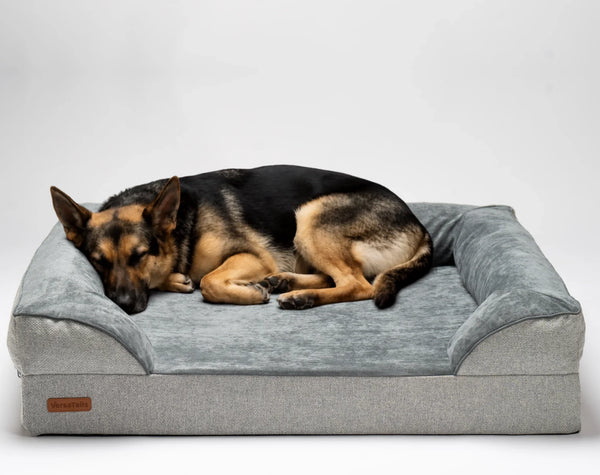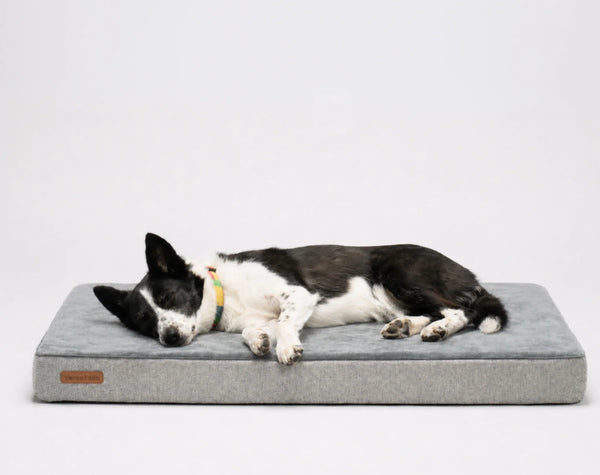




You bought a bed that looked thick and plush. A year later it looks like a rug with a zipper, and your dog has moved back to the couch.
That is rarely the dog's fault, and rarely yours. Beds go flat because of what is inside them. Once you know the three usual causes, you can check any bed in about ten seconds.
What "flat" really means
A bed is flat when the filling no longer pushes back. Your dog lies down, the filling gives way, and their weight ends up resting on the floor underneath.
The cover can still look fine, which is why a flat bed is easy to miss.
Three reasons dog beds go flat
1. Loose fill shifts and packs down. Polyester fiberfill is the fluffy stuffing in most pillow-style beds. It feels soft on day one. Under repeated weight the fibers mat together and drift toward the edges, so the middle, where your dog sleeps, ends up the thinnest part.
2. Egg crate foam holds less foam than it seems to. Egg crate foam is a sheet cut into peaks and valleys. It looks thick, but the valleys are thin and the peaks carry all the weight on small points. Those peaks are the first thing to fold over.
3. A single soft layer has nothing underneath it. Memory foam is made to give way slowly and mold around the body. That is what makes it comfortable. On its own, under a heavy dog, it keeps giving until it reaches the floor. It needs a firmer, springier layer below it to push back. The bigger the dog, the more this matters. More on that in what big and senior dogs need from a bed.

How to tell if a dog bed is flat: the 10-second press test
You do not need tools for this. You need a hard floor and your fist.
1. Leave the bed where it normally sits, on a hard floor.
2. Make a fist and press it into the middle of the bed, where your dog usually lies. Lean in with real weight.
3. Notice what your knuckles meet. If you feel foam pushing back, the bed is still doing its job. If you feel the floor, the bed has bottomed out.
4. Let go and watch the surface. It should rise back and level out within a few seconds. A dent that stays is filling that has stopped recovering.
5. Repeat near an edge your dog rarely uses. If the edge feels much thicker than the middle, the middle has worn down.
A fist concentrates weight, so some give is normal. What you are checking for is the floor.

Four more signs you can see
- A dip in the middle of the bed when nobody is on it.
- A cover that looks loose or wrinkled where it used to sit tight.
- A bed you can fold in half with one hand.
- A dog who lies next to the bed, or half on and half off it. Dogs choose their spots for many reasons, but it is a good cue to run the press test.
What a bed that holds its shape is made of
Beds that stay supportive tend to share a few things. For the full buyer's checklist, see what to look for in a dog bed.
- Solid foam, not loose or cut fill. A slab cannot drift to the edges.
- Layers with different jobs. A softer layer on top for comfort, and a firmer, high-resilience layer underneath that pushes back.
- A waterproof liner around the foam. A foam core cannot go in the washing machine, so the liner is what keeps it clean and dry.
- A warranty that names flattening. A promise against "defects" is vague. A promise against flattening, with a measurement, is one you can hold a brand to.

How we built the VersaTails bed
The VersaTails® Orthopedic Dog Bed uses three solid foam layers: Cooling Gel Memory Foam on top, Orthopedic Memory Foam in the middle, and a High-Resilience Support Base underneath.
The top two layers cushion the body and ease pressure. The base is the layer that pushes back, so a large dog rests on foam and not on the floor.
The bed is covered by our 1-Year No-Flatten Warranty. If the foam core flattens or indents by more than two inches, we replace the mattress core. Full terms are on our warranty page.
FAQ
How long should a dog bed last?
It depends on what is inside the bed and on the size of the dog using it, so there is no honest single number. The press test tells you more than the calendar does.
Can I fix a dog bed that has gone flat?
Loose fiberfill can be fluffed or topped up for a while. Foam that has stopped springing back cannot be restored.
Does a thicker bed stay supportive longer?
Not on thickness alone. Six inches of loose fill can flatten faster than a thinner bed built from solid layers. What matters is what the layers are and whether the bottom one pushes back.